Table of Contents
- Is a Quantity Surveyor Worth It? What You Actually Get
- What a Quantity Surveyor Does on a Self-Build
- Quantity Surveyor Cost: What Drives the Fee
- When to Hire a Quantity Surveyor for a Self-Build
- What a Quantity Surveyor Cost Plan Should Contain
- Quantity Surveyor vs Project Manager: Who Does What
- Where the Value Shows Up (and Where It Doesn’t)
- Conclusion
- Frequently Asked Questions
Last Updated: 19 October 2026
Is a Quantity Surveyor Worth It? What You Actually Get
A quantity surveyor is a construction cost specialist who plans, checks and controls what a build costs from first sketch to final account (What is a quantity surveyor? | Salary, skills and more). For most self-builders, that means one thing: knowing your real costs before you commit to a mortgage or a land purchase.
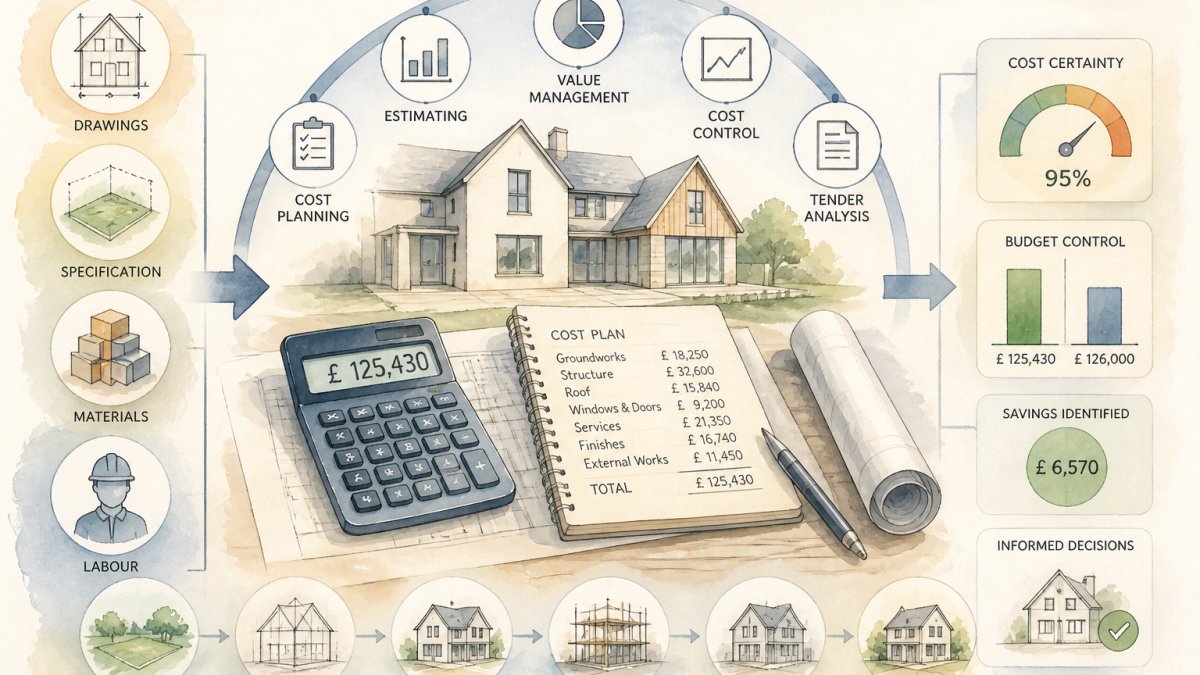
So is a quantity surveyor worth it? In most self-builds, yes, because lenders want cost certainty and builders price from drawings. A quantity surveyor turns both into a document you can act on. At Self Build UK, our in-house quantity surveyors produce cost plans from supplied plans.
Below, we break down what you get, what it costs, and where the value stops.
What a Quantity Surveyor Does on a Self-Build
A quantity surveyor measures your drawings and prices the work. That is the core of the job.
From there, the role covers:
- Cost planning: an early estimate before detailed drawings exist
- Digital take-off: measuring quantities from your plans
- Tender analysis: comparing builder quotes like for like
- Valuations: checking what a builder has actually earned each month
- Change control: pricing variations before work starts
- Final account: agreeing the last payment
A common mistake is hiring one only at tender stage. By then, the design decisions that drive cost are already locked in.
Ask for the take-off as a spreadsheet, not just a PDF. You can then check quantities against builder quotes line by line, which is where most overcharges hide.
Quantity Surveyor Cost: What Drives the Fee
Quantity surveyor cost depends on the size and complexity of the build, not on a fixed rate card. Fees vary by region, by how detailed the drawings are, and by how much of the build you want monitored.
The main drivers are:
- Project value: bigger builds mean more measuring and more risk
- Design complexity: bespoke shapes, glazing and structural work take longer
- Drawing quality: incomplete plans mean assumptions and caveats
- Scope of service: a one-off cost plan costs less than monthly valuations
- Stage: early feasibility work is lighter than full tender and contract support
We do not publish fixed prices because every report is scoped to the plans. Ask Self Build UK for a quote based on your drawings.
When to Hire a Quantity Surveyor for a Self-Build
Hire a quantity surveyor before you exchange on land or apply for a self-build mortgage. Those two moments need cost certainty, and both are hard to reverse.
The right timing usually looks like this:
- Feasibility: a rough cost check before you buy a plot
- Planning: a cost plan alongside your application
- Mortgage application: a detailed report your lender can rely on
- Tender: analysis of builder quotes
- Construction: monthly valuations and change control
If you are managing the build yourself, you still benefit. A quantity surveyor gives you a benchmark to test builder prices against, which matters more when there is no contractor checking the numbers.
Skipping a pre-purchase cost check is the most expensive shortcut in self-build. Plots with awkward access, drainage issues or sloping ground can add costs that dwarf the survey fee.
What a Quantity Surveyor Cost Plan Should Contain
A quantity surveyor cost plan should break the build down by trade, add contingency and fees, and show a total you can take to a lender. Anything less is a guess with a logo on it.
A proper plan includes:
- Build cost by trade: groundworks, structure, envelope, services, finishes
- Contingency: a separate line, not buried in rates
- Professional fees: architect, engineer, building control, warranty
- Preliminaries: site setup, scaffolding, welfare, insurance
- Total project cost: including VAT where it applies
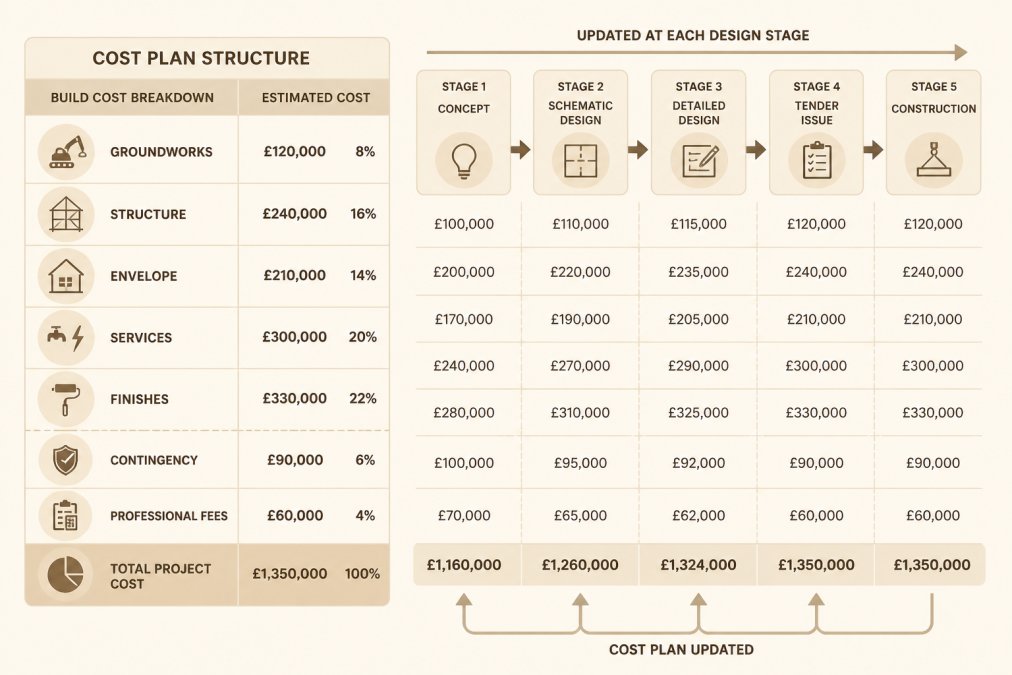
The plan should also state its assumptions. That is what makes it useful when a builder queries a rate.
Quantity Surveyor vs Project Manager: Who Does What
A quantity surveyor controls cost; a project manager controls time, trades and quality. They overlap, but they are not the same job.
| Task | Quantity Surveyor | Project Manager |
|---|---|---|
| Cost plan and budget | Yes | Reviews it |
| Measuring quantities | Yes | No |
| Tendering and quote analysis | Yes | Supports it |
| Programme and sequencing | No | Yes |
| Site coordination | No | Yes |
| Monthly valuations | Yes | Checks progress |
| Change pricing | Yes | Approves timing |
On smaller self-builds, one person often covers both roles. On bespoke or larger builds, splitting them gives you a cost check on the person running the site.
Where the Value Shows Up (and Where It Doesn’t)
The value shows up in decisions made early, when changes are still cheap. It shows up less once the roof is on.
Where a quantity surveyor earns their fee:
- Catching missing items before a builder prices them as extras
- Giving your lender a cost report they accept
- Comparing quotes on the same measured basis
- Pricing variations before you agree to them
Where the value is thinner:
- Very small, simple builds with fixed-price quotes
- Projects where drawings never reach a usable stage
- Builds where you ignore the report and proceed anyway
The honest answer to whether a quantity surveyor is worth it comes down to risk. If a cost overrun would break your budget or your mortgage, the report is cheap insurance. If you have a fixed-price contract and deep contingency, the case is weaker.
The earlier a quantity surveyor sees your plans, the more the fee is worth. Late involvement turns cost control into cost reporting.
Conclusion
The real challenge in self-build is not finding a builder. It is knowing what the build should cost before anyone quotes you.
Self Build UK assigns an in-house quantity surveyor to every project, produces a digital take-off from your plans, and prices against current regional benchmark rates. Reports arrive as PDF and Excel, with a personal consultation to walk you through the numbers.
Book a free consultation with Self Build UK and start your build with a cost plan you can take to your lender.
Frequently Asked Questions
Is it worth hiring a quantity surveyor for a self-build?
For most self-builds, yes. A quantity surveyor turns drawings into a trade-by-trade cost breakdown before you commit to a build. That matters most when you need a lender to approve a mortgage, when you are tendering to contractors, or when you are managing trades yourself. The fee is typically a small fraction of the total build cost, and the main value is catching omissions and pricing gaps early, when they are still cheap to fix.
How much does a quantity surveyor cost?
Quantity surveyor cost depends on the size and complexity of the design, the level of detail you need, and how many revisions are required. A single cost report for a bespoke home costs less than ongoing monthly cost management across a full build. Because every project is priced individually, ask for a fixed quote based on your plans rather than relying on a headline rate. Compare the fee against the size of the contingency you would otherwise carry.
Can a quantity surveyor save you money?
The savings usually come from three places: a more accurate tender pack that reduces contractor risk pricing, early identification of expensive design details, and a cost plan that stops scope creep before it reaches site. A quantity surveyor cost plan also gives you a benchmark to challenge quotes that look high. The saving is not guaranteed, but the cost of discovering a shortfall mid-build is far higher than the fee for getting the numbers right first.
What is the difference between a quantity surveyor and a project manager?
A quantity surveyor owns the money: cost planning, tender analysis, valuations, variations and final accounts. A project manager owns the programme and the site: sequencing trades, coordinating deliveries, and keeping the build on schedule. On a self-build these roles can overlap, and some people cover both. If your budget is tight or your design is unusual, the quantity surveyor is usually the first appointment because cost certainty unlocks the mortgage and the build.